

Wednesday, November 30, 2016

Tuesday, November 29, 2016
Mortgage Interest Rates Just Went Up... Should I Wait to Buy?
 Mortgage interest rates, as reported by Freddie Mac, have increased over the last several weeks. Along with Freddie Mac, Fannie Mae, the Mortgage Bankers Association and the National Association of Realtors are all calling for mortgage rates to continue to rise over the next four quarters. This has caused some purchasers to lament the fact they may no longer be able to get a rate less than 4%. However, we must realize that current rates are still at historic lows. Here is a chart showing the average mortgage interest rate over the last several decades.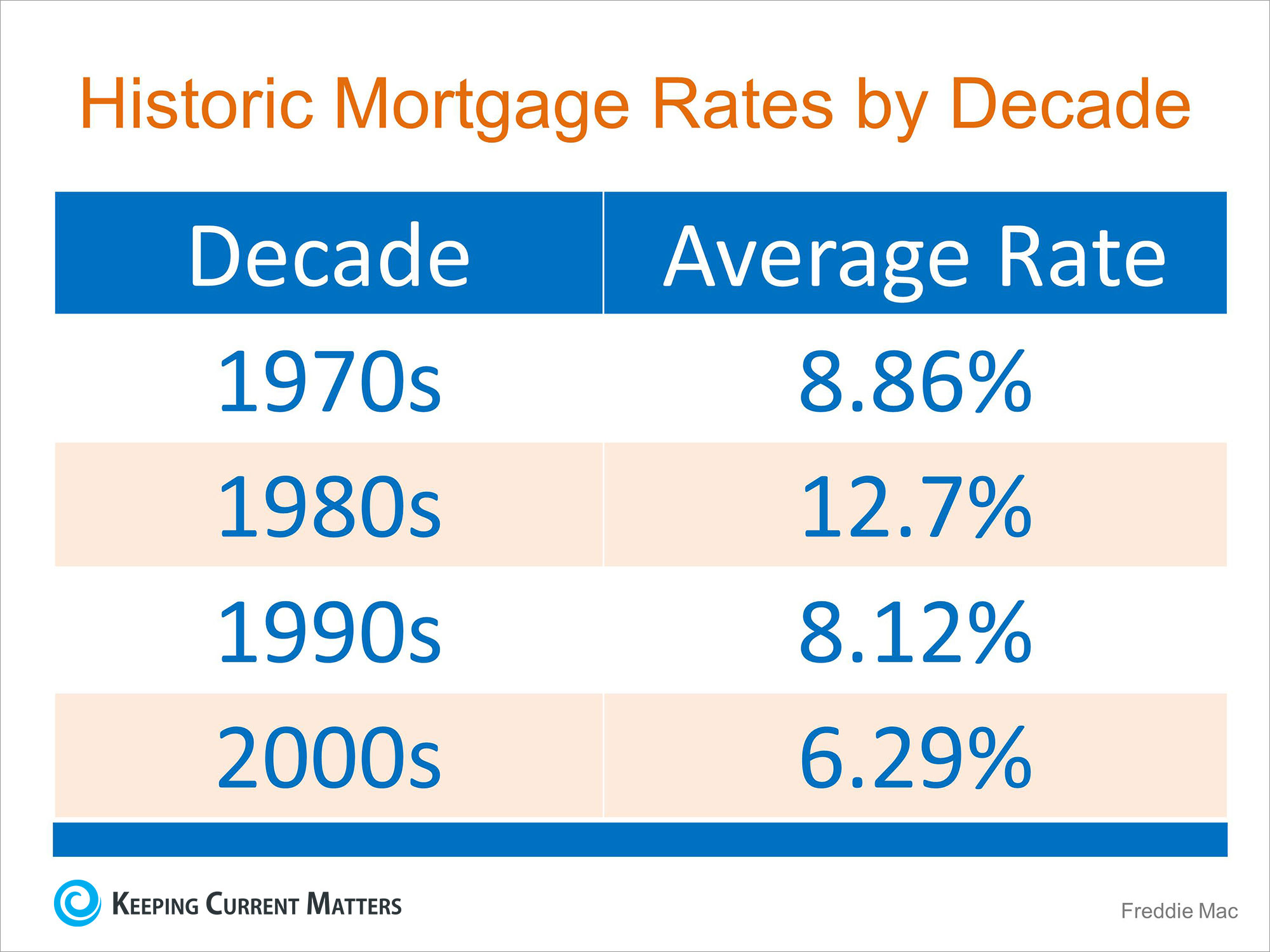
Bottom Line
Though you may have missed getting the lowest mortgage rate ever offered, you can still get a better interest rate than your older brother or sister did ten years ago; a lower rate than your parents did twenty years ago and a better rate than your grandparents did forty years ago.Monday, November 28, 2016
The Dangers of "Tight Mortgage Credit" Headlines
 The availability of mortgage credit is not at the same level that it was during the boom in housing (2005), and that's good news. However, the constant headlines which talk about "tight credit" are causing some potential home buyers to doubt their ability to purchase. We want to rectify the misconception of what is required for a down payment in order to purchase a home in today's market. Freddie Mac recently discussed the confusion many first-time homebuyers have about the down payment they need in order to buy:
"Did you know that the average down payment among first-time homebuyers is 6% and it's 13-14% for repeat buyers...It's possible to put down even less. Many potential homebuyers think that only the FHA helps make mortgage loans with low down payments. Not true. Freddie Mac's Home Possible mortgage products let qualified homebuyers put down as little as 3%."Brenda Garcia Lemus of John Burns Real Estate Consulting reports that this is also the case with newly constructed homes:
"Our home-builder clients sell hundreds of homes every weekend to buyers with 5% down payments and below average credit scores. Yet, many middle-income households with average credit and access to a 5% down payment assume they cannot become homeowners because of the 'tight credit' headlines."
Bottom Line
Before you 'disqualify' yourself, check with a professional in your market to find out what is possible in mortgaging today.Friday, November 25, 2016
Thinking of Selling? Don't Overlook an Outdated Kitchen, Buyers Won't
 If you are planning on listing your home for sale, make sure that you don't overlook the condition of your kitchen. A recent article on realtor.com listed "7 Signs Your Kitchen Is Way Overdue for a Renovation," in which they warned:
"Dated kitchens--just like bathrooms--are a major barrier for resale. Buyers want modern amenities and styling, and most aren't interested in renovating post-purchase."Kitchen remodels can be pricey, with many complete remodels costing $20,000 or more. But not every kitchen needs a full remodel. There are many smaller projects that will help buyers see themselves trying their favorite Pinterest recipe in your home! Here are a couple of project ideas that, if you're handy or know someone who is, could end up boosting your home's value without breaking the bank:
- Are the cabinets in good shape but need an update? A new coat of paint and some updated hardware will instantly freshen up the space and drastically change the feel of the room all for under $300.
- A new backsplash to match the freshly painted cabinets updates the space and adds some style while staying under $200, depending on the size of the room.
- If the kitchen seems dark, consider adding LED under cabinet lighting for around $40.
- If replacing the countertops in the kitchen isn't within your budget, consider using a top coat to cover the current countertops.
"Eighty-two percent of homeowners said their updated kitchen gave them a greater desire to be at home, and 95% were happy or satisfied with the result."
Bottom Line
Kitchens and bathrooms are often make or break for buyers when touring a home or searching through photo galleries online. Consult a local real estate professional who can help you identify which small projects could pay off big!Wednesday, November 23, 2016
A Lack of Listings Remains 'Huge' Challenge in the Market
 The housing crisis is finally in the rearview mirror as the real estate market moves down the road to a complete recovery. Home values are up, home sales are up, and distressed sales (foreclosures & short sales) are at their lowest mark in over 8 years. This has been, and will continue to be, a great year for real estate. However, there is one thing that may cause the industry to tap the brakes: a lack of housing inventory. According to the National Association of Realtors (NAR), buyer traffic and demand continues to be the strongest it has been in years. The supply of homes for sale has not kept up with this demand and has driven prices up in many areas as buyers compete for their dream home. Traditionally, the winter months create a natural slowdown in the market. Jonathan Smoke, Chief Economist at realtor.com, points to low interest rates as one of the many reasons why buyers are still out in force looking for a home of their own.
"Overall, the fundamental trends we have been seeing all year remain solidly in place as we enter the traditionally slower sales season, and pent-up demand remains substantial as buyers seek to get a home under contract while rates remain so low."NAR's Chief Economist, Lawrence Yun, points out that the inventory shortage we are currently experiencing isn't a new challenge by any means:
"Inventory has been extremely tight all year and is unlikely to improve now that the seasonal decline in listings is about to kick in. Unfortunately, there won't be much relief from new home construction, which continues to be grossly inadequate in relation to demand."
Bottom Line
Healthy labor markets and job growth have created more and more buyers who are not just ready and willing to buy but are also able to. If you are debating whether or not to put your home on the market this year, now is the time to take advantage of the demand in the market.Why Are Mortgage Interest Rates Increasing?
 According to Freddie Mac's latest Primary Mortgage Market Survey, the 30-year fixed rate mortgage interest rate jumped up to 3.94% last week. Interest rates had been hovering around 3.5% since June, and many are wondering why there has been such a significant increase so quickly. According to Freddie Mac's latest Primary Mortgage Market Survey, the 30-year fixed rate mortgage interest rate jumped up to 3.94% last week. Interest rates had been hovering around 3.5% since June, and many are wondering why there has been such a significant increase so quickly.Why did rates go up?Whenever there is a presidential election, there is uncertainty in the markets as to who will win. One way that this is noticeable is through the actions of investors. As we get closer to the first Tuesday of November, many investors pull their funds from the more volatile and less predictive stock market and instead, choose to invest in Treasury Bonds. When this happens, the interest rate on Treasury Bonds does not have to be as high to entice investors to buy them, so interest rates go down. Once the elections are over and a President has been elected, investors return to the stock market and other investments, leaving the Treasury to raise rates to make bonds more attractive again. Simply put, the better the economy, the higher interest rates will go. For a more detailed explanation of the many factors that contribute to whether interest rates go up or down, you can follow this link to Investopedia.The Good NewsEven though rates are closer to 4% than they have been in nearly 6 months, they are still slightly below where we started 2016, at 3.97%. The great news is that even at 4%, rates are still significantly lower than they have been over the last 4 decades, as you can see in the chart below.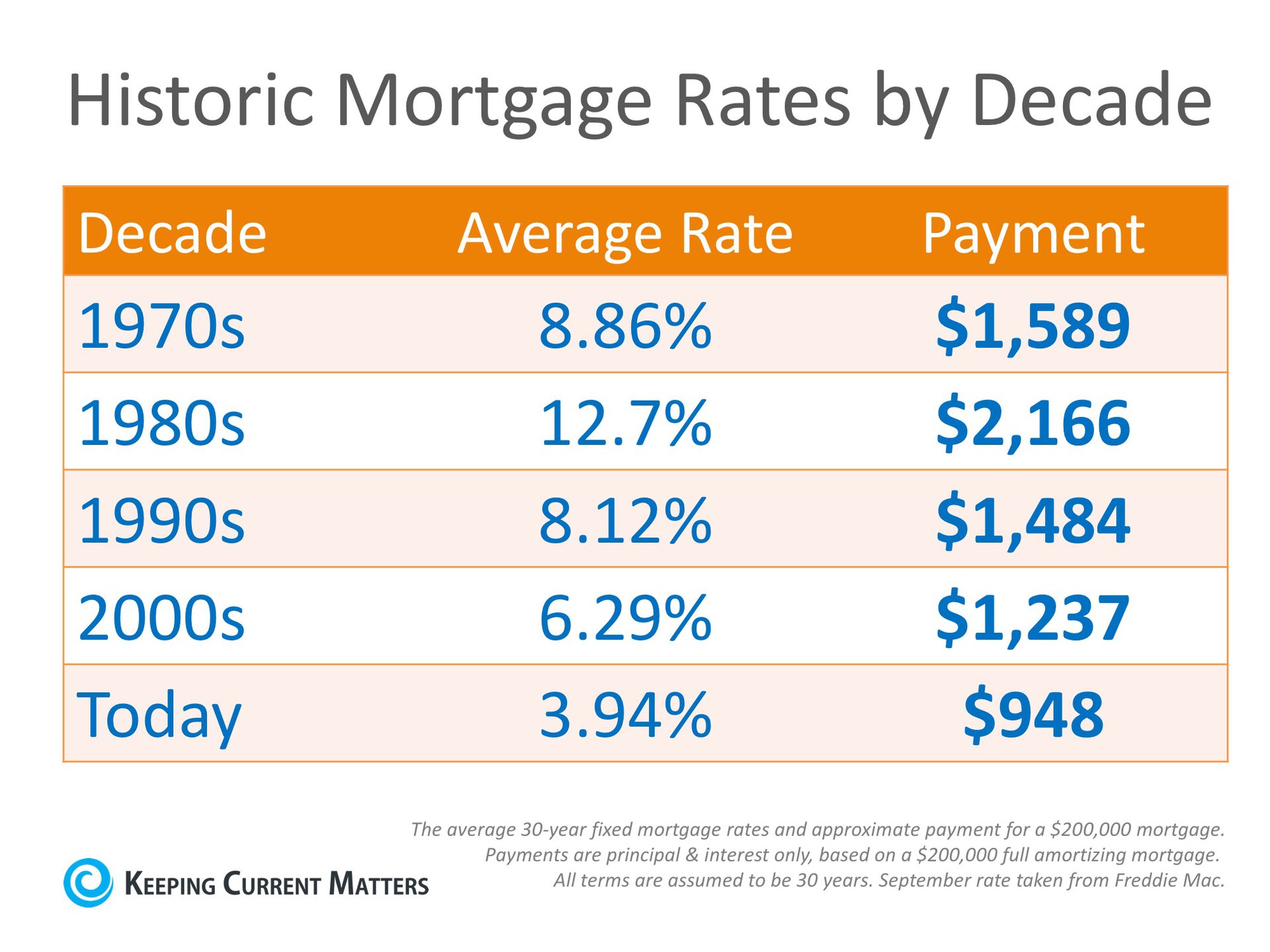 Any increase in interest rate will impact your monthly housing costs when you secure a mortgage to buy your home. A recent Wall Street Journal article points out that, "While still only roughly half the average over the past 45 years, according to Freddie Mac, the quick rise has lenders worried that home loans could become more expensive far sooner than anticipated." Tom Simons, a Senior Economist at Jefferies LLC, touched on another possible outcome for higher rates: Any increase in interest rate will impact your monthly housing costs when you secure a mortgage to buy your home. A recent Wall Street Journal article points out that, "While still only roughly half the average over the past 45 years, according to Freddie Mac, the quick rise has lenders worried that home loans could become more expensive far sooner than anticipated." Tom Simons, a Senior Economist at Jefferies LLC, touched on another possible outcome for higher rates:"First-time buyers look at the monthly total, at what they can afford, so if the mortgage is eaten up by a higher interest expense then there's less left over for price, for the principal. Buyers will be shopping in a lower price bracket; thus demand could shift a bit." Bottom LineInterest rates are impacted by many factors, and even though they have increased recently, rates would have to reach 9.1% for renting to be cheaper than buying. Rates haven't been that high since January of 1995, according to Freddie Mac. |
Monday, November 21, 2016
NAR Reports Show Now Is a Great Time to Sell!
 We all realize that the best time to sell anything is when demand is high and the supply of that item is limited. The last two major reports issued by the National Association of Realtors (NAR) revealed information that suggests that now continues to be a great time to sell your house. Let's look at the data covered by the latest Pending Home Sales Report and Existing Home Sales Report.
THE PENDING HOME SALES REPORT
The report announced that pending home sales (homes going into contract) are up 2.4% over last year, and have increased year-over-year now for 22 of the last 25 consecutive months. Lawrence Yun, NAR's Chief Economist, had this to say:"The one major predicament in the housing market is without a doubt the painfully low levels of housing inventory in much of the country. It's leading to home prices outpacing wages, properties selling a lot quicker than a year ago and the home search for many prospective buyers being highly competitive and drawn out because of a shortage of listings at affordable prices."Takeaway: Demand for housing will continue throughout the end of 2016 and into 2017. The seasonal slowdown often felt in the winter months did not occur last winter and shows no signs of returning this year.
THE EXISTING HOME SALES REPORT
The most important data point revealed in the report was not sales, but was instead the inventory of homes for sale (supply). The report explained:- Total housing inventory rose 1.5% to 2.04 million homes available for sale
- That represents a 4.5-month supply at the current sales pace
- Unsold inventory is 6.8% lower than a year ago, marking the 16th consecutive month with year-over-year declines
"Inventory has been extremely tight all year and is unlikely to improve now that the seasonal decline in listings is about to kick in. Unfortunately, there won't be much relief from new home construction, which continues to be grossly inadequate in relation to demand."In real estate, there is a guideline that often applies; when there is less than a 6-month supply of inventory available, we are in a seller's market and we will see appreciation. Between 6-7 months is a neutral market, where prices will increase at the rate of inflation. More than a 7-month supply means we are in a buyer's market and should expect depreciation in home values. As Yun notes, we are, and will remain, in a seller's market with prices still increasing unless more listings come to the market.
"There's hope the leap in sales to first-time buyers can stick through the rest of the year and into next spring. The market fundamentals -- primarily consistent job gains and affordable mortgage rates -- are there for the steady rise in first-timers needed to finally reverse the decline in the homeownership rate."Takeaway: Inventory of homes for sale is still well below the 6-month supply needed for a normal market. Prices will continue to rise if a 'sizable' supply does not enter the market.
Bottom Line
If you are going to sell, now may be the time to take advantage of the ready, willing, and able buyers that are still out looking for your house
Subscribe to:
Posts (Atom)