Thursday, August 25, 2022

Should You Buy a Home with Inflation This High?


While the Federal Reserve is working hard to bring down inflation, the latest data shows the inflation rate is still going up. You no doubt are feeling the pinch on your wallet at the gas pump or the grocery store, but that news may also leave you wondering: should I still buy a home right now?

Greg McBride, Chief Financial Analyst at Bankrateexplains how inflation is affecting the housing market:

Inflation will have a strong influence on where mortgage rates go in the months ahead. . . . Whenever inflation finally starts to ease, so will mortgage rates — but even then, home prices are still subject to demand and very tight supply.”

No one knows how long it’ll take to bring down inflation, and that means the future trajectory of mortgage rates is also unclear. While that uncertainty isn’t comfortable, here’s why both inflation and mortgage rates are important for you and your homeownership plans.

When you buy a home, the mortgage rate and the price of the home matter. Higher mortgage rates impact how much you’ll pay for your monthly mortgage payment – and that directly affects how much you can comfortably afford. And while there’s no denying it’s more expensive to buy and finance a home this year than it was last year, it doesn’t mean you should pause your search. Here’s why.

Homeownership Is Historically a Great Hedge Against Inflation

In an inflationary economy, prices rise across the board. Historically, homeownership is a great hedge against those rising costs because you can lock in what’s likely your largest monthly payment (your mortgage) for the duration of your loan. That helps stabilize some of your monthly expenses. Not to mention, as home prices continue to appreciate, your home’s value will too. That’s why Mark Cussen, Financial Writer at Investopediasays: 

Real estate is one of the time-honored inflation hedges. It’s a tangible asset, and those tend to hold their value when inflation reigns, unlike paper assets. More specifically, as prices rise, so do property values.”

Also, no one is calling for homes to lose value. As Selma Hepp, Deputy Chief Economist at CoreLogicsays:

“The current home price growth rate is unsustainable, and higher mortgage rates coupled with more inventory will lead to slower home price growth but unlikely declines in home prices.”

In a nutshell, your home search doesn’t have to go on hold because of rising inflation or higher mortgage rates. There’s more to consider when it comes to why you want to buy a home. In addition to shielding yourself from the impact of inflation and growing your wealth through ongoing price appreciation, there are other reasons to buy a home right now like addressing your changing needs and so much more.

Bottom Line

Homeownership is one of the best decisions you can make in an inflationary economy. You get the benefit of the added security of owning your home in a time when experts are forecasting prices to continue to rise.

Tuesday, August 23, 2022

What Sellers Need To Know in Today's Housing Market


If you’re thinking about selling your house, you may have heard about the housing market slowing down in recent months. While it’s still a sellers’ market, the peak frenzy the market saw over the past two years has cooled some. If you’re asking yourself if you’ve missed your chance to sell your house and make a move, the good news is you haven’t – motivated buyers are still out there. But you do need to price your house right for today’s market. Here’s why.

As Lawrence Yun, Chief Economist at the National Association of Realtors (NAR), says:

Homes priced right are selling very quickly, but homes priced too high are deterring prospective buyers.”

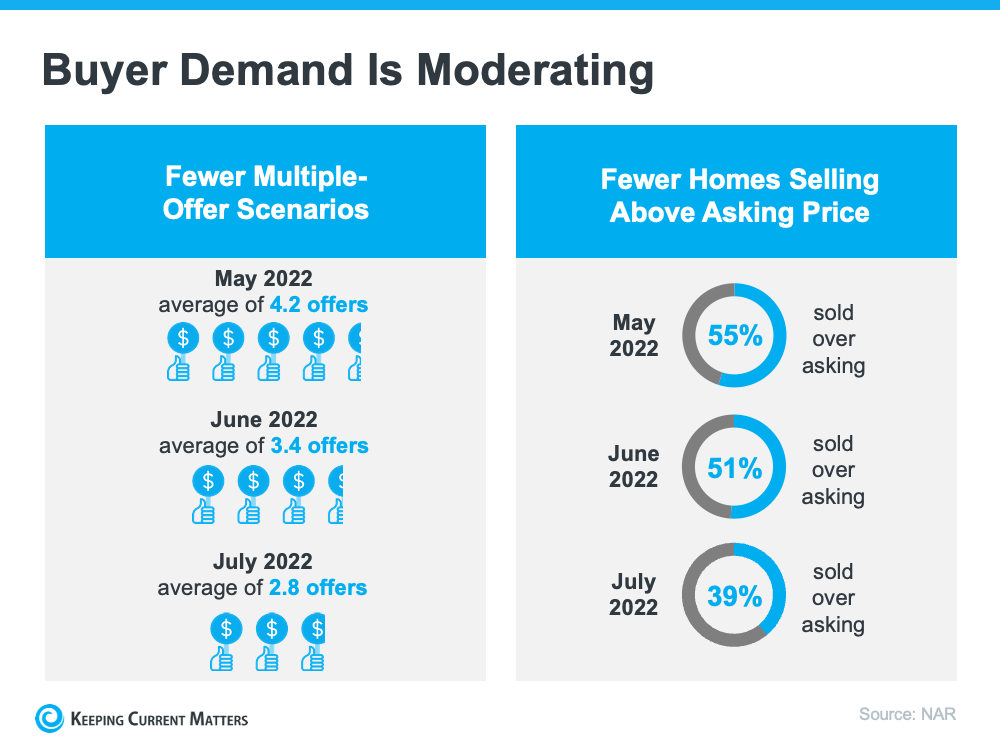
It’s true buyer demand has slowed over the past few months as higher mortgage rates made it more expensive to buy a home. The result is fewer bidding wars and less competition among buyers (see visual below):

What Sellers Need To Know in Today’s Housing Market | Keeping Current Matters

But don’t forget – that’s compared to the severely overheated market we saw over the past two years. According to the latest Confidence Index from NAR:

“. . . 39% of homes sold above list price, down from 51% a month ago and 50% a year ago.”

While this is a slower pace than even one month ago, serious buyers are still actively in the market, and they’re buying homes that are priced right. In fact, the Confidence Index also notes the average home is selling in just 14 days.

If you’re aiming to sell your house, be sure you’re working with your agent to price it for today’s housing market. As buyer demand softens, it’s important to understand this isn’t the same market as last year. It’s not even the same market as just a few months ago. But it is still a sellers’ market.

If you’re ready to sell your house, seek the advice of a real estate professional. In some cases, you’ll need to adjust your expectations accordingly to meet the market where it is today. Selma Hepp, Interim Lead, Deputy Chief Economist at CoreLogicexplains what’s happening and what it means when you sell:

Signs of a broader slowdown in the housing market are evident, . . . This is in line with our previous expectations and given the notable cooling of buyer demand due to higher mortgage rates. . . . Nevertheless, buyers still remain interested, which is keeping the market competitive — particularly for attractive homes that are properly priced.”

Bottom Line

While the housing market has cooled from its overheated frenzy, it’s still a sellers’ market. Work with a real estate professional to understand what’s happening with buyer demand and home prices in your local area as you get ready to enter the market.

Friday, August 12, 2022

Selling Your House? Your Asking Price Matters More Now Than Ever


There’s no doubt about the fact that the housing market is slowing from the frenzy we saw over the past two years. But what does that mean for you if you’re thinking of selling your house?

While home prices are still appreciating in most markets and experts say that will continue, they’re climbing at a slower pace because rising mortgage rates are creating less buyer demand. Because of this, there are more homes on the market. And in a shift like this one, the way you price your home matters more than ever.

Why Today’s Housing Market Is Different

During the pandemic, sellers could price their homes higher because demand was so high, and supply was so low. This year, things are shifting, and that means your approach to pricing your house needs to shift too.

Because we’re seeing less buyer demand, sellers have to recognize this is a different market than it was during the pandemic. Here’s what’s at stake if you don’t.

Why Pricing Your House at Market Value Matters

The price you set for your house sends a message to potential buyers. If you price it too high, you run the risk of deterring buyers.

When that happens, you may have to lower the price to try to reignite interest in your house when it sits on the market for a while. But be aware that a price drop can be seen as a red flag for some buyers who will wonder what that means about the home or if in fact it’s still overpriced. Some sellers aren’t adjusting their expectations to today’s market, and realtor.com explains the impact that’s having:

“. . . the share of listings with a price cut was nearly double its year ago level even as it remains well below pre-pandemic levels.”

To avoid the headache of having to lower your price, you’ll want to price it right from the onset. A real estate advisor knows how to determine that perfect asking price. To find the right price, they balance the value of homes in your neighborhood, current market trends and buyer demand, the condition of your house, and more.

Not to mention, pricing your house fairly based on market conditions increases the chance you’ll have more buyers who are interested in purchasing it. This helps lead to stronger offers and a greater likelihood it’ll sell quickly.

Why You Still Have an Opportunity When You Sell Today

Rest assured, it’s still a sellers’ market, and you’ll still get great benefits if you plan accordingly and work with an agent to set your price at the current market value. As Lawrence Yun, Chief Economist at the National Association of Realtors (NAR), says:

Homes priced right are selling very quickly, but homes priced too high are deterring prospective buyers.”

Mike Simonsen, the Founder and CEO of Altos Research, also notes:

“We can see that demand is still there for the homes that are priced properly.”

Bottom Line

Home priced right are selling quickly in today’s real estate market. Partner with a real estate professional to make sure you price your house based on current market conditions so you can maximize your sales potential and minimize your hassle in a shifting market.

Tuesday, August 9, 2022

Talking Points to Calm Consumers' Housing Bubble Fears


Talking Points to Calm Consumers’ Housing Bubble Fears

As concerns about a looming recession mount, help buyers and sellers understand that this market, though volatile, is not on the trajectory of another housing crash.

July 14, 2022
 

This spring, about 45% of home sellers said they believed the housing market was headed for a crash in 2022, according to a study from Clever Real Estate. To boot, Google Trends data shows a significant spike in searches for the term “housing bubble.” Doomsday fears are mounting as record-high home prices make more consumers and real estate professionals nervous that the market may be overheated.

But “we almost surely are not” in a housing bubble, says James McGrath, co-founder of the New York–based real estate brokerage Yoreevo. Still, he’s been fielding concerns from clients lately about how a slowing economy could impact real estate. Most leading housing economists agree that the market isn’t in bubble territory. While home prices have never been higher, the market today is considerably different than in 2008 during the last housing crash. So, arm yourself with some talking points to help answer your clients’ questions about the state of the market and calm their concerns.

For one, instead of a housing surplus, like there was in 2008, the nation is facing a severe inventory shortage. Homebuilders put more than 2 million housing units a year into the pipeline in the years leading up to the 2008 bubble and were overbuilding at the time, notes Lawrence Yun, chief economist for the National Association of REALTORS®. “Today, it is exactly the opposite,” he says. “The country is still facing historically low inventory levels and low rental vacancy rates that are the consequences of multiple years of underproduction.”

But how about those surging home prices? After all, the median price of an existing home was $407,600 in May—the first time ever that this figure exceeded $400,000, according to NAR data. Have some markets overheated? Possibly. But economists put it into perspective: A 5% price correction in, say, places like Phoenix could be possible—but that comes after about a 50% price gain in just the last two years. “Even if there were to be a localized price correction, it will not cause harm to the [overall] housing market or to the financial banking system,” Yun says. “Some buyers will simply view it as a second-chance opportunity to get into the market after being outbid by others over the past two years, and the balance sheets of the banking industry are quite strong. So maybe prices would adjust downward—or maybe not. Let it be because it doesn’t really matter this time.”

Housing dynamics remain strong, even as the double-digit price appreciation we’ve become accustomed to begins to slow. NAR predicts the pace of price appreciation to moderate to about 5% or 6% by the end of the year.

Let’s Talk About It

You may hear comments from clients like: “I’m worried about buying. This is a housing bubble.” Here are some tips and talking points to consider:

  • Don’t dismiss fears. Many homeowners remember the 2008 housing crash, when they may have seen their own home’s value plummet or lost their property to foreclosure. Many millennials, who are the strongest homebuying force today, watched their parents struggle to keep up with their mortgage payments, scaring them off their own homeownership path. Their concerns about a “housing bubble 2.0” may come from a deep place, so acknowledge their fear and let them know that their feelings are legitimate.
  • Mortgages are structured differently. The kind of subprime lending that was blamed for the 2008 crash is a much smaller and more regulated part of the market today. “The lenders and regulators do not want to make the same mistake of lending to people who cannot repay the mortgage,” Yun says. “Therefore, the credit scores of mortgage approvals have been high.” The typical credit score for a mortgage borrower was a near-record 776 in the first quarter of 2022. During the Great Recession, it dipped to 707. Plus, for adjustable-rate mortgages, which have fluctuating interest rates over a set period of years, borrowers nowadays must show they can afford the fully reset rate, says Glenn Brunker, president of mortgage servicer Ally Homes.
  • Housing inventories remain low. The nation is roughly 3 million homes short of meeting buyer demand, Freddie Mac estimates. NAR has called for a “once-in-a-generation response” to the supply crisis. About 1.2 million single-family housing starts are predicted for 2023—still far from the 2 million–plus in the early 2000s, according to Statista data. Yun says housing inventory likely will remain an issue for years to come.
  • Buyer demand remains high. Purchasing a house was the top accomplishment postgraduate students aspire to achieve—more than getting a successful job, getting married, having a baby, or traveling, according to a Grand Canyon University survey. “There is still too much real demand and too little inventory,” McGrath says about the state of the housing market. “Affordability has taken a hit with higher [mortgage] rates, but people still want to buy homes.”
  • Real estate can be a hedge against inflation. Locking in a fixed-rate mortgage now will protect homeowners against future increases in housing prices. Such an opportunity doesn’t exist when you’re renting, and rental prices have climbed drastically over the last year. Plus, renting doesn’t offer the ability to build equity.
  • A market correction is not the same as a crash. The housing market has showed recent signs of slowing. But “based on present evidence, there is no expectation that a fallout from a housing correction would be comparable to the 2007–09 global financial crisis in terms of magnitude or macroeconomic gravity,” a group of Dallas Fed economists wrote this spring.

Some markets may experience a slight decrease in home prices as the market readjusts. In June, more than 40% of home sellers dropped their asking price in places like Salt Lake City; Boise, Idaho; Sacramento, Calif.; and other Western hot spots, according to Redfin data.

Homebuying costs have increased $800 every month this year due to higher mortgage rates and home prices, according to Nadia Evangelou, NAR’s senior economist and director of forecasting. The 30-year fixed-rate mortgage, which averaged 2.9% just a year ago, was at 5.51% for the week ending July 14, according to Freddie Mac. “Rising interest rates and buyer fatigue from bidding wars have caused the market to stabilize and return closer to normal, but the market still favors home sellers,” says Scott Orich, a sales associate with Flyhomes in San Mateo, Calif.

Orich has been talking to his home sellers about the importance of pricing their home right for the changing market. “Be more realistic with your expectations, and be patient,” Orich says. “The mad rush of multiple buyers is over.”

Even though the rise in mortgage rates is certainly bracing for house hunters, a large group of buyers is “more focused on buying a home—and hopefully at a slightly more reasonable price than they’d pay three or six months ago,” McGrath says. Also, “they want to be confident they’re not buying into a repeat of 2008.” And you can help them understand that they are not.

Thursday, August 4, 2022

A Real Estate Professional Helps You Separate Fact from Fiction


If you’re following the news, chances are you’ve seen or heard some headlines about the housing market that don’t give the full picture. The real estate market is shifting, and when that happens, it can be hard to separate fact from fiction. That’s where a trusted real estate professional comes in. They can help debunk the headlines so you can really understand today’s market and what it means for you.

Here are three common housing market myths you might be hearing, along with the expert analysis that provides better context.

Myth 1: Home Prices Are Going To Fall

One piece of fiction many buyers may have seen or heard is that home prices are going to crash. That’s because headlines often use similar, but different, terms to describe what’s happening with prices. A few you might be seeing right now include:

  • Appreciation, or an increase in home prices.
  • Depreciation, or a decrease in home prices.
  • And deceleration, which is an increase in home prices, but at a slower pace.

The fact is, experts aren’t calling for a decrease in prices. Instead, they forecast appreciation will continue, just at a decelerated pace. That means home prices will continue rising and won’t fall. Selma Hepp, Deputy Chief Economist at CoreLogic, explains:

“. . . higher mortgage rates coupled with more inventory will lead to slower home price growth but unlikely declines in home prices.”

Myth 2: The Housing Market Is in a Correction

Another common myth is that the housing market is in a correction. Again, that’s not the case. Here’s why. According to Forbes:

“A correction is a sustained decline in the value of a market index or the price of an individual asset. A correction is generally agreed to be a 10% to 20% drop in value from a recent peak.

As mentioned above, home prices are still appreciating, and experts project that will continue, just at a slower pace. That means the housing market isn’t in a correction because prices aren’t falling. It’s just moderating compared to the last two years, which were record-breaking in nearly every way.

Myth 3: The Housing Market Is Going To Crash

Some headlines are generating worry that the housing market is a bubble ready to burst. But experts say today is nothing like 2008. One of the reasons why is because lending standards are very different today. Logan Mohtashami, Lead Analyst for HousingWire, explains:

“As recession talk becomes more prevalent, some people are concerned that mortgage credit lending will get much tighter. This typically happens in a recession, however, the notion that credit lending in America will collapse as it did from 2005 to 2008 couldn’t be more incorrect, as we haven’t had a credit boom in the period between 2008-2022.”

During the last housing bubble, it was much easier to get a mortgage than it is today. Since then, lending standards have tightened significantly, and purchasers who acquired a mortgage over the last decade are much more qualified than they were in the years leading up to the crash.

Bottom Line

No matter what you’re hearing about the housing market, trust the experts and partner with a local real estate professional. When you do, you’ll have a knowledgeable authority on your side that knows the ins and outs of the market, including current trends, historical context, and so much more.