Monday, February 12, 2018

Study Shows "Millennials Deserve More Credit"

Study Shows "Millennials Deserve More Credit" | Keeping Current Matters
When it comes to talking about millennials, there are many stereotypes out there that have influenced the way the public feels about the generation. Whether it’s the assumption that millennials are irresponsible with money and would rather buy avocado toast than save for a down payment, or that millennials jump from job to job, the majority of these stereotypes paint the generation in a negative light.
A new study by Bank of America entitled Better Money Habits Millennial Report recently came to the defense of the generation when it reported that:
“Millennials deserve more credit – both from themselves and from others – for their mindfulness when it comes to money and their lives.”
Here are some key takeaways from the study proving that millennials deserve more credit for what they are already doing:
  • 63% are saving – (47% have $15,000 or more in savings)
  • 54% are budgeting – (73% who have a budget stick to it every month)
  • 57% have a savings goal – (67% who have a goal stick to it every month)
  • 46% have asked for a raise in the past 2 years – (80% who asked for a raise got one)
  • 59% feel financially secure – (16% have $100,000 or more in savings)
Many have wondered if millennials even want to own their own homes or if they would choose to rent instead. Well, not only do they want to own their own homes, but many already do and are looking to trade up! A recent study by realtor.com shows that 49% of Americans who plan to sell their home in the next 12 months are millennials!
Danielle Hale, realtor.com’s Chief Economist, gave some insight into why millennials are looking to sell,
“The housing shortage forced many first-time homebuyers to consider smaller homes and condos as a way to literally get their foot in the door. Our survey data reveals that we may see more of these homes hitting the market in the next year.”

Bottom Line

Not every millennial fits into the stereotypes that are so prominent in our society. Those who have risen above the stereotype are ready and willing to buy a home of their own, and many others already have!

Friday, February 9, 2018

2 Major Myths Holding Back Home Buyers

Urban Institute recently released a report entitled, “Barriers to Accessing Homeownership,” which revealed that eighty percent of consumers either are unaware of how much lenders require for a down payment or believe all lenders require a down payment above 5 percent.”

Myth #1: “I Need a 20% Down Payment”

Buyers often overestimate the down payment funds needed to qualify for a home loan. According to the same report:
Consumers are often unaware of the option to take out low-down-payment mortgages. Only 19% of consumers believe lenders would make loans with a down payment of 5% or less… While 15% believe lenders require a 20% down payment, and 30% believe lenders expect a 20% down payment.”
These numbers do not differ much between non-owners and homeowners; 39% of non-owners believe they need more than 20% for a down payment and 30% of homeowners believe they need more than 20% for a down payment.
While many believe that they need at least 20% down to buy their dream home, they do not realize that programs are available that allow them to put down as little as 3%. Many renters may actually be able to enter the housing market sooner than they ever imagined with programs that have emerged allowing less cash out of pocket.

Myth #2: “I Need a 780 FICO® Score or Higher to Buy”

Similar to the down payment, many either don’t know or are misinformed about what FICO® score is necessary to qualify.
Many Americans believe a ‘good’ credit score is 780 or higher.
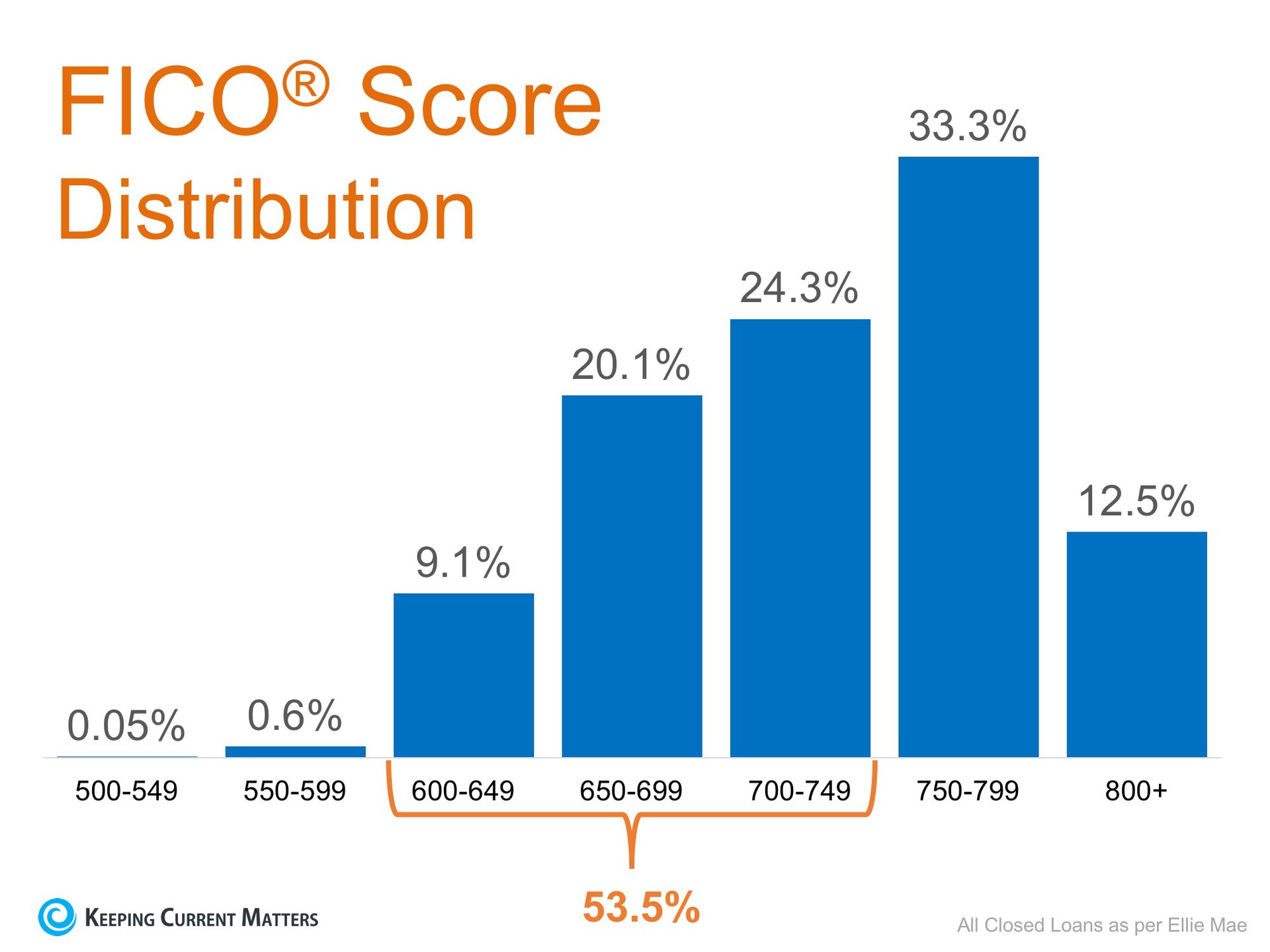
To help debunk this myth, let’s take a look at Ellie Mae’s latest Origination Insight Report, which focuses on recently closed (approved) loans.
2 Major Myths Holding Back Home Buyers | Keeping Current Matters
As you can see in the chart above, 53.5% of approved mortgages had a credit score of 600-749.

Bottom Line

Whether buying your first home or moving up to your dream home, knowing your options will make the mortgage process easier. Your dream home may already be within your reach.

Thursday, February 8, 2018

Buying A Home Is More Affordable Than Renting In 54% Of US Counties

Buying A Home Is More Affordable Than Renting In 54% Of US Counties | Keeping Current Matters
According to ATTOM Data Solutions’ 2018 Rental Affordability Report, “buying a median-priced home is more affordable than renting a three-bedroom property in 240 of 447 [or 54% of] U.S. counties analyzed for the report.”
For the report, ATTOM Data Solutions compared recently released fair market rent data from the Department of Housing and Urban Development with reported income amounts from the Department of Labor and Statistics to determine the percentage of income that a family would have to spend on their monthly housing cost (rent or mortgage payments).
Daren Blomquist, Senior Vice President of ATTOM Data Solutions had this to say:
“Although buying is still more affordable than renting in the majority of U.S. housing markets, the majority is shrinking as home price appreciation continues to outpace rental growth in most areas.”
However, the report also shows that the average fair market rent rose faster than average weekly wages in 60% of the counties analyzed in the report (266 of 447 counties). With rents rising, many renters should consider buying a home soon.

Bottom Line

Rents will continue to rise, and mortgage interest rates are still at historic lows. Before you sign or renew your next lease, meet with a local professional who can help you determine if you are able to buy a home of your own and lock in your monthly housing expense.

Tuesday, February 6, 2018

If You're Considering Selling, ACT NOW!!

Definitely an aggressive headline. However, as the final data on the 2017 housing market rolls in, we can definitely say one thing: If you are considering selling, IT IS TIME TO LIST YOUR HOME!

How did we finish 2017?

  1. New-home sales were at their highest level in a decade.
  2. Sales of previously owned homes were at their highest level in more than a decade.
  3. Starts of single-family homes were their strongest in a decade and applications to build such properties advanced to the fastest pace since August 2007.
And Bloomberg Business just reported:
“America’s housing market is gearing up for a robust year ahead. Builders are more optimistic, demand is strong and lean inventory is keeping prices elevated.”
And the National Association of Realtors revealed that buyer traffic is stronger this winter than it was during the spring buying season last year.
The only challenge to the market is a severe lack of inventory. A balanced market would have a full six-month supply of homes for sale. Currently, there is less than a four-month supply of inventory. This represents a decrease in supply of 9.7% from the same time last year.

Bottom Line

With demand increasing and supply dropping, this may be the perfect time to get the best price for your home

Sunday, February 4, 2018

Bidding Wars Abound... How Long Will They Continue?

Bidding Wars Abound… How Long Will They Continue? | Keeping Current Matters
Just like with any product or service, the law of supply and demand impacts home prices. Any time that there is less supply than the market demands, prices increase.
In many areas of the country, the supply of homes for sale in the starter and trade-up home markets is so low that bidding wars have ensued, and the busy spring-buying season is just around the corner.
CoreLogic recently conducted an analysis on national home prices at the time of sale for their January 2018 MarketPulse Report and found that a third of homes sold for at least list price.
“The share selling above list price was almost three times the trough in January 2008 and represented more than one-fifth of total sales.”
Many markets in the western part of the country and around major cities are experiencing higher shares of homes selling above list price.
“San Francisco had the largest share of homes—76 percent—that sold for at least the list price, and Seattle and Los Angeles followed with 63 and 51 percent, respectively. Miami had the lowest share—16 percent—of homes selling at or above the list price.”
Increased demand during the spring and summer months, the traditionally busier seasons for real estate, will no doubt influence how many homes continue to sell over list price.
This should not be seen by sellers as permission to overprice their homes, though. Buyers are becoming more and more educated, especially those who have been searching for their dream homes for a while now while waiting for new inventory to come to market.
Realtor.com gives this advice:
“Aim to price your property at or just slightly below the going rate. Today’s buyers are highly informed, so if they sense they’re getting a deal, they’re likely to bid up a property that’s slightly underpriced, especially in areas with low inventory.”

Saturday, February 3, 2018

Why You Need a Professional on Your Team When Buying a Home

Why You Need a Professional on Your Team When Buying a Home | Keeping Current Matters
Many people wonder whether they should hire a real estate professional to assist them in buying their dream homes or if they should first try to go through the buying process on their own. In today’s market: you need an experienced professional!

You Need an Expert Guide If You Are Traveling a Dangerous Path

The field of real estate is loaded with landmines; you need a true expert to guide you through the dangerous pitfalls that currently exist. Finding a home that is priced appropriately and is ready for you to move into can be tricky. An agent listens to your wants and needs, and can sift through the homes that do not fit within the parameters of your “dream home.”
A great agent will also have relationships with mortgage professionals and other experts that you will need in order to secure your dream home.

You Need a Skilled Negotiator

In today’s market, hiring a talented negotiator could save you thousands, perhaps tens of thousands, of dollars. Each step of the way – from the original offer to the possible renegotiation of that offer after a home inspection, to the possible cancellation of the deal based on a troubled appraisal – you need someone who can keep the deal together until it closes.
Realize that when an agent is negotiating his or her commission with you, they are negotiating their own salary; the salary that keeps a roof over their family’s head; the salary that puts food on their family’s table. If they are quick to take less when negotiating for themselves and their families, what makes you think they will not act the same way when negotiating for you and your family?
If they were Clark Kent when negotiating with you, they will not turn into Superman when negotiating with the buyer or seller in your deal.

Bottom Line

Famous sayings become famous because they are true. You get what you pay for. Just like a good accountant or a good attorney, a good agent will save you money…not cost you money.

Thursday, February 1, 2018

11 Reasons Why Your Home Isn’t Selling

When you first put your house on the market, you might be hopeful for a quick sale—especially if you've put a lot of money into improving the house over the years and if the neighborhood is one that has historically attracted a lot of buyers. While you shouldn't panic if the house doesn't sell the moment you list it, you should begin to worry if the months start flying by without any real offers. If this is the case, here are 11 reasons why your house may not be selling.
  1. You overvalued your property. If your house is overpriced, it's simply not going to sell. Compare your property to similar properties that recently sold within your area to get a better idea of its true value. An experienced real estate agent can give you an accurate value of your home. Additionally, don't make the mistake of tacking on the cost of any renovations you made. You can't just assume that the cost of a renovation translates to added value.
  1. Your listing is poor. If the listing of your home includes a poorly written description without any images, a lot of buyers are going to skip over it. Make sure you and your REALTOR® put an effort into creating a listing that attracts the attention of buyers. Make sure to add high quality photographs of both the interior and exterior of your home. Don't forget to highlight unique features as well.
  1. You're always present at showings. Let your agent handle your showings. Buyers don't want to have the seller lurking over their shoulder during showings, especially during an open house. This puts unwanted pressure on the buyer, which will make them uncomfortable and likely chase them away.
  1. You're too attached. If you refuse to negotiate even a penny off your price, then there's a good chance that you've become too attached to your home. If a part of you doesn't want to sell it, or you think your house is the best house in the world, odds are you're going to have a lot of difficulties coming to an agreement with a potential buyer.
  1. You haven't had your home professionally cleaned. A dirty house is going to leave a bad impression on buyers. Make sure you have a professional clean your carpeting and windows before you begin showing your house.
  1. You haven't staged your home. If you've already moved out, then don't show an empty house. This makes it difficult for buyers to imagine living in it. Stage your house with furniture and decor to give buyers a better idea of how big every room is and how it can be used. You want the buyer to feel at home when they are taking the tour.
  1. You kept up all of your personal décor. Buyers are going to feel uncomfortable touring your house if you keep all of your family portraits up. Take down your personal décor so that buyers can have an easier time imagining themselves living there.
  1. Your home improvements are too personalized. You might think that the comic book mural you painted for your child's room is absolutely incredible, but that doesn't mean potential buyers will agree. If your home improvements are too personalized, it can scare off buyers who don't want to pay for features they don't want.
  1. Your home is too cluttered. Even if your home is clean, clutter can still be an issue. For example, maybe you simply have too much furniture in one of your rooms. This can make the house feel smaller than it is.
  1. Your home is in need of too many repairs. The more repairs that are needed, the less likely a buyer will want your house. Many buyers simply don't want to deal with the cost or effort of doing repair work, even if it's just a bunch of small repairs, such as tightening a handrail or replacing a broken tile.
  1. You chose the wrong real agent. In my opinion, choosing the right real estate is simply the most important decision you make in selling your home.  A good REALTOR® makes all the difference in selling your home within a reasonable time.
All these things can be fixed once you realize your mistake; however, the longer your property stays on the market, the less likely it will sell at listing price. One of the best ways to avoid making these common mistakes is by working with a professional real estate agent.