 The National Association of Realtors (NAR) keeps historic data on many aspects of homeownership. One of the data points that has changed dramatically is the median tenure of a family in a home. As the graph below shows, for over twenty years (1985-2008), the median tenure averaged exactly six years. However, since 2008, that average is almost nine years - an increase of almost 50%. The National Association of Realtors (NAR) keeps historic data on many aspects of homeownership. One of the data points that has changed dramatically is the median tenure of a family in a home. As the graph below shows, for over twenty years (1985-2008), the median tenure averaged exactly six years. However, since 2008, that average is almost nine years - an increase of almost 50%. 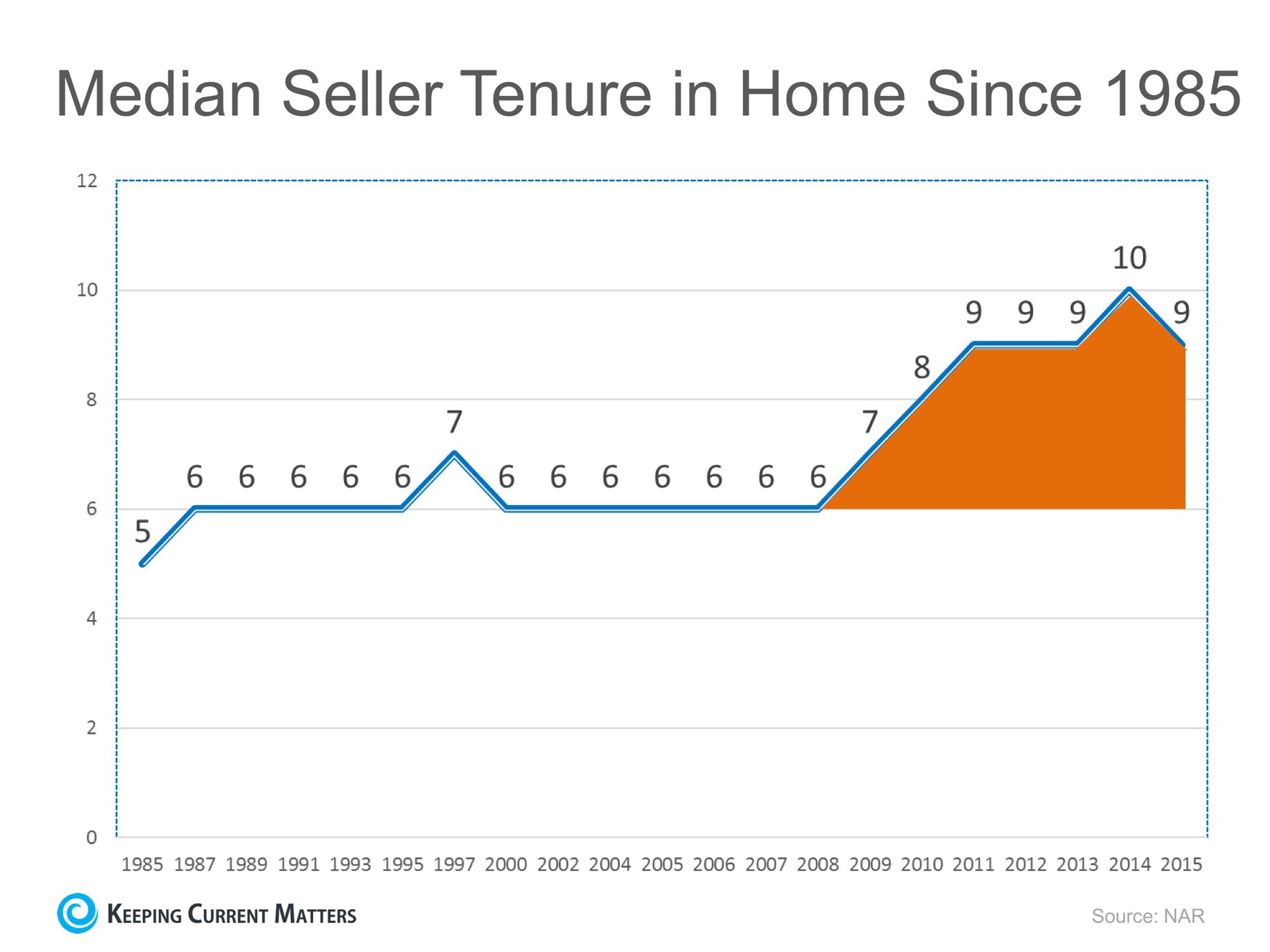 Why the dramatic increase?The reasons for this change are plentiful. The top two reasons are:
What does this mean for housing?Many believe that a large portion of homeowners are not in a house that is best for their current family circumstances. They could be baby boomers living in an empty, four-bedroom colonial, or a millennial couple planning to start a family that currently lives in a one-bedroom condo. These homeowners are ready to make a move. Since the lack of housing inventory is a major challenge in the current housing market, this could be great news. |

Wednesday, November 9, 2016
How Long Do Families Stay in a Home?

Monday, November 7, 2016
Are Millennials Taking Over The Housing Market?
Millennials haven’t taken over the housing market yet, but it’s only a matter of time before they do.
Many Millennials have not moved into homeownership due to a number of factors, including a preference for urban living and a high student debt burden.
However, now first First American created a chart that shows Millennials have a higher percentage of people with a college degree than any other generation.

(Source: First American)
This educational advantage bodes well for future homeownership rates among this generation. A study from Fannie Mae showed that the long-term benefit of a college degree outweighs the short-term burden of student loan debt when it comes to the likelihood of eventual homeownership.
The study showed that those who earned a degree without taking on student debt are the most likely to become homeowners, followed by those who graduated with debt, those who never went to college and lastly, those who took on student debt but never graduated.
So Millennials' status as not only the largest demographic but also the most educatedgeneration ever could soon lead to abnormally high homeownership rates. That could come with a downside, however.
“The risk will be that prices will adjust to all of the demand and reduce affordability, making it more difficult,” First American Financial Corp. Chief Economist Mark Fleming told HousingWire.
“That’s why the issue of lack of inventory, whether in the form of less existing home sales than expected or a lack of right-priced new homes, is so important to the future success of the market to serve the possible tsunami of demand,” Fleming said.
Freddie Mac also thinks an influx in Millennial buyers is likely, and there is evidence this could already be starting. Existing home sales increased in September, driven mainly by a dramatic increase in first-time homebuyers, which reached the highest share of homebuyers in four years, according to a report from the National Association of Realtors.
Saturday, November 5, 2016
The Difference An Hour Makes
![The Difference an Hour Makes This Fall [INFOGRAPHIC] | Keeping Current Matters](http://www.keepingcurrentmatters.com/wp-content/uploads/2016/10/20161104-ENG-KCM-1.jpg)
Every Hour in the US Housing Market:
- 633 Homes Sell
- 253 Homes Regain Positive Equity
- Median Home Values Go Up $1.43
Saturday, October 29, 2016
What to Expect When Home Inspecting
 So you made an offer, it was accepted, and now your next task is to have the home inspected prior to closing. More often than not, your agent may have made your offer contingent on a clean home inspection. This contingency allows you to renegotiate the price paid for the home, ask the sellers to cover repairs, or even, in some cases, walk away. Your agent can advise you on the best course of action once the report is filed. So you made an offer, it was accepted, and now your next task is to have the home inspected prior to closing. More often than not, your agent may have made your offer contingent on a clean home inspection. This contingency allows you to renegotiate the price paid for the home, ask the sellers to cover repairs, or even, in some cases, walk away. Your agent can advise you on the best course of action once the report is filed.How to Choose an InspectorYour agent will most likely have a short list of inspectors that they have worked with in the past that they can recommend to you. Realtor.com suggests that you consider the following 5 areas when choosing the right home inspector for you:
Bottom LineThey say 'ignorance is bliss,' but not when investing your hard-earned money in a home of your own. Work with a professional you can trust to give you the most information possible about your new home so that you can make the most educated decision about your purchase |
Thursday, October 27, 2016
Starting to Look for a Home? Know What You WANT vs. What You NEED
 In this day and age of being able to shop for anything anywhere, it is really important to know what you're looking for when you start your home search. If you've been thinking about buying a home of your own for some time now, you've probably come up with a list of things that you'd LOVE to have in your new home. Many new homebuyers fantasize about the amenities that they see on television or Pinterest, and start looking at the countless homes listed for sale with rose-colored glasses. Do you really need that farm sink in the kitchen in order to be happy with your home choice? Would a two-car garage be a convenience or a necessity? Could the man cave of your dreams be a future renovation project instead of a make or break now? The first step in your home buying process should be to get pre-approved for your mortgage. This allows you to know your budget before you fall in love with a home that is way outside of it. The next step is to list all the features of a home that you would like, and to qualify them as follows:
- 'Must Haves' - if this property does not have these items, then it shouldn't even be considered. (ex: distance from work or family, number of bedrooms/bathrooms)
- 'Should Haves' - if the property hits all of the must haves and some of the should haves, it stays in contention, but does not need to have all of these features.
- 'Absolute Wish List' - if we find a property in our budget that has all of the 'must haves,' most of the 'should haves,' and ANY of these, it's the winner!
Bottom Line
Having this list flushed out before starting your search will save you time and frustration, while also letting your agent know what features are most important to you before starting to show you houses in your desired area.Wednesday, October 26, 2016
Do You Know the Cost of Renting vs. Buying?
![Do You Know the Cost of Renting vs. Buying? [INFOGRAPHIC] | Keeping Current Matters](http://www.keepingcurrentmatters.com/wp-content/uploads/2016/10/20161014-Rent-vs.-Buy-KCM.jpg)
Some Highlights:
- Historically, the choice between renting or buying a home has been a close decision.
- Looking at the percentage of income needed to rent a median priced home today (30%) vs. the percentage needed to buy a median priced home (15%), the choice becomes obvious.
- Every market is different. Before you renew your lease again, find out if you could use your housing costs to own a home of your own!
How Historically Low Interest Rates Increase Your Purchasing Power
 According to Freddie Mac's latest Primary Mortgage Market Survey, interest rates for a 30-year fixed rate mortgage are currently at 3.47%. Rates have remained at or below 3.5% each of the last 16 weeks, marking a historic low. The interest rate you secure when buying a home not only greatly impacts your monthly housing costs, but also impacts your purchasing power. Purchasing power, simply put, is the amount of home you can afford buy for the budget you have available to spend. As rates increase, the price of the house you can afford will decrease if you plan to stay within a certain monthly housing budget. The chart below shows what impact rising interest rates would have if you planned to purchase a home within the national median price range, and planned to keep your principal and interest payments at or about $1,100 a month.
 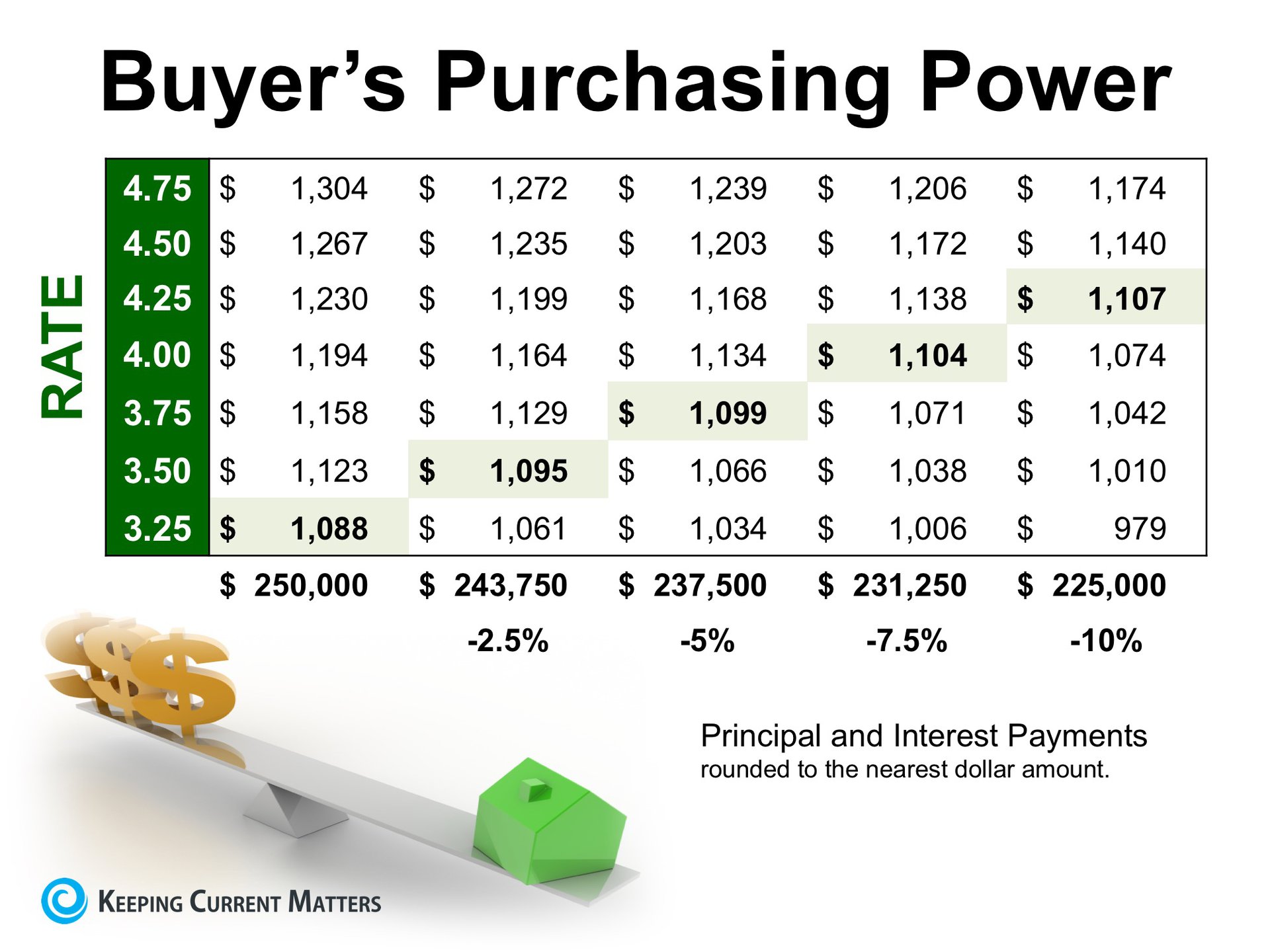 With each quarter of a percent increase in interest rate, the value of the home you can afford decreases by 2.5%, (in this example, $6,250). Experts predict that mortgage rates will be closer to 4% by this time next year. Act now to get the most house for your hard earned money.
Subscribe to:
Posts (Atom)