Friday, July 31, 2015

Are Home Values REALLY at Record Levels?

Are Home Values REALLY at Record Levels? | Keeping Current MattersLast week, the National Association of Realtors (NAR) released their Existing Home Sales Report. The report announced that the median existing-home price in June was $236,400. That value surpasses the peak median sales price set in July 2006 ($230,400). This revelation created many headlines exclaiming that home prices had hit a “new record”:

Wall Street JournalExisting-Home Prices Hit Record

USA Today: Existing home sales surge, prices hit record

Though the headlines are accurate, we want to take a closer look at the story. We do not want people to believe that this information is evidence that a new “price bubble” is forming in housing. NAR reports the median home price. That means that 50% of the homes sold above that number and 50% sold below that number. With fewer distressed properties (lower valued) now selling, the median price will rise. The median value does not reflect that each individual property is increasing in value. Below are the commentsfrom Bill McBride, the author of the esteemed economic blog Calculated Risk. McBride talks about the challenges with using the median price and also explains that in “real” prices (taking into consideration inflation) we are nowhere close to a record.
“In general I'd ignore the median sales price because it is impacted by the mix of homes sold (more useful are the repeat sales indexes like Case-Shiller or CoreLogic). NAR reported the median sales price was $236,400 in June, above the median peak of $230,400 in July 2006. That is 9 years ago, so in real terms, median prices are close to 20% below the previous peak. Not close.”
Earlier this week, the Wall Street Journal covered this issue in detail. In this story, Nick Timiraos explained that this rise in median prices is nothing to be concerned about:
“Does this mean we have another problem on our hands? Not really…There may be other reasons to worry about housing affordability by comparing prices with incomes or prices with rents for a given market. But crude comparisons of nominal home prices with their 2006 and 2007 levels shouldn’t be used to make cavalier claims about a new bubble.”

Bottom Line

Home values are appreciating. However, they are not increasing at a rate that we should have fears of a new housing bubble around the corner.

Tuesday, July 28, 2015

Cost Across Time Average Interest Rate and Mortgage Payment

Cost Across Time [INFOGRAPHIC] | Keeping Current MattersSome Highlights:
  • With interest rates still around 4% now is a great time to look back at where rates have been over the last 40 years.
  • Rates are projected to go up a full percentage point by this time next year according to Freddie Mac.
  • The impact your interest rate makes on your monthly mortgage cost is significant!
  • Lock in a low rate now while you can!

Sunday, July 26, 2015

Top 10 Things that can go wrong during a Real Estate Transactin

Every day in real estate is a fresh, new day!  I think that's what most of us love about this business - there's never a day that is just 'mundane' - in fact, no two transactions are ever the same!  Some go so smoothly, you arrive at the Closing table and can't believe that there hasn't been on bump in the road.  
Others...well, not so much!

10.  Buyer remorse - In an era of bidding wars, it's human nature to want to 'WIN!'  A few days after winning the bidding war, especially if buyers have gone significantly higher than list price, buyers tend to feel a little remorse.  Some, to the extreme, ultimately making the decision to terminate the Contract to purchase the home.
9.  Unknown structural issues arise - One of the BEST ways to avoid this is to have a pre-inspection when you are listing your home.  This way, if there are structural issues, you have time to remedy them prior to the sale.  Buyers are typically terrified (albeit they don't always need to be terrified) of structural issues, which can cause a cancellation of the sale.
8.  SURPRISE!  You've got MOLD! - This can also be a deal-killer and again, can be avoided with a pre-inspection.
7.  Buyer has been pre-approved - but, wait!  Buyer has NO CREDIT! - Yes, this has happened to a buyer for one of my listings.  The lender issued a pre-approval letter based on income only.  The buyer had NEVER had a car loan, credit card or student loan and therefore, when the documents got to the underwriter, the file was rejected!  Of course, the deal fell through but, the seller was able to quickly take the back-up buyer and seal the deal!
6.  WAIT!  You can't take it with you! - Listing agents review the Offer to Purchase in NC with a Seller when the listing documents are prepared.  I also review the FIXTURES with Sellers when we receive an Offer.  MOST Sellers get it but, on occasion, a Seller will remove an item deemed a permanent fixture and the Buyer is NOT happy about it!  This typically happens with items like curtain rods, chandeliers and even refrigerators.  Conversely, Buyers think that all appliances remain with a property - check to be certain that you've included your request for refrigerator, washer or dryer - items that ARE personal property in our state but, may not have been in your exit state.
5.  Sellers failed to properly complete repairs - As a Seller, your best best is to hire a contractor to make all of the repairs.  Be certain that this contractor offers a warranty as well.  Having someone handle all repairs also makes your life easier - after all, you are packing to move and this is a very busy time for you.  You honestly don't need to be running to Lowe's to buy caulking or plumbing items - just let someone else handle that work for you.  This way, if it is not done properly, the responsibility falls on the contractor to come back and make it right.
4.  Lender drops the ball - One reason to be SURE to use your Realtor® recommendations when it comes to lenders.  Just as all real estate agents are not created equally, nor are lenders!    Thankfully we realized this (yes, the Seller side realized it first!) in time to have the new lender meet the Closing deadline.  We (the Sellers) demanded that the Buyers utilize one of our preferred lenders who got the job done in 10 days...appraisal and all!
Don't let these mishaps happen to you when selling your home3.  Faulty appraisal - This happens for a variety of reasons but, the top two reasons are that the appraisers have difficulty showing appreciation within a community whereas it's easy to show depreciation.  The second reason this occurs is appraisal management companies send appraisers from out-reaching areas and they are not familiar with the comparable properties enough to generate an accurate appraisal.  
2.  Buyer Converts Auto Lease to Purchase (or, buys a new car!) - This doesn't fly with lenders if your debt-to-income ratios are tight.  It's best not to make ANY purchases with credit or your savings until AFTER the Closing.  This way, you aren't in jeopardy of losing your new home and all of the money that you've spent in preparation of being the new homeowner (inspection costs, due diligence fees, earnest money deposit, appraisal costs, Title search costs, etc.)
1.  The SELLER decides not to SELL! - Yes, I've had a BUYER change their minds on the day before Closing (and even the day OF Closing) but, never a Seller!  We had a Buyer who had worked through inspections, appraisal and was headed to Closing, only to receive the call, "I'm so sorry but, the Seller has changed their mind - they're not going to be selling their home!"  Buyers have the right to recoup damages, including but, not limited to any and all costs associated with their home purchase.  If you're thinking of selling your home, be 100% sure that you are prepared to go through with the sale before you list your home for sale!

Saturday, July 25, 2015

money puzzle

So you want to buy a house! But first you need a car. And you want to get married in a big wedding, and then have some babies. Don’t forget their college education, and your master’s degree, and the looming specter of retirement.
Life often feels like a series of savings goals. Once you’ve paid off your student loans, there are a half-dozen other major costs lying ahead. The most ominous? Buying a house—a dream that might seem unachievable when you want other things, too.
But having it all doesn’t have to be stressful. Here are some financial adviser-approved techniques for saving for multiple goals—all at the same time.

1. Review your spending

There’s a reason this is the first bullet point in any financial advice story: You can’t make any serious savings inroads without first taking a good, hard look at your spending.
Before diving into hard-core budgeting, financial adviser Cheryl Vesely of Balance Financial Planning always forces her clients to analyze their current spending.
Don’t try to whittle down your spending without tracking it first—otherwise, you’ll set unrealistic goals and be disappointed when you don’t achieve them. Vesely recommends starting by evaluating fixed expenses, such as streaming TV services or your gym membership.
Here’s another tip: Search for purchases where the amount you spend exceeds your joy.
“Your fourth pair of shoes is not as fun as your third pair,” Vesely says. “Try to step back a little on things you don’t appreciate as much.”

2. Prioritize (and visualize) your goals

Chances are good your down payment will be the biggest priority, but paying for your kid’s college might be up there, too.
Or perhaps you want a wedding in two years, and ideally you’d like a home in five—how do you choose which goal to focus on?
For many home buyers, it’ll come down to which timeline has the most flexibility, says Jason Hull, a financial planner in Fort Worth, TX.
If you’ve already set a date for your wedding, for instance, maybe you need to consider renting for another year or two.
And when saving gets tricky, think about the future. Actually, don’t just think. Visualize.
“Mentally imagine you are watching a movie where future you is starring, doing whatever it is you’re trying to do,” Hull says. This helps combat the part of your brain that wants instant gratification.

3. Try the ‘snowball method’

If you’ve ever tuned in to financial guru Dave Ramsey’s radio show, you’ve probably heard him advocate for the debt snowball method: Knock out your debts one at a time, from smallest to largest.
That means you shouldn’t feel bad about putting most of your savings toward something smaller first—again, assuming your home purchase isn’t on a tight deadline. Accomplishing one financial goal might be the push you need to keep saving.

4. Separate your money

If you do decide to save for multiple goals at once, make sure to keep your savings in different accounts.
Many banks easily allow you to create as many accounts as you’d like, but Vesely also recommends online options such as SmartyPig. Keeping the money separate helps mentally separate “house savings” from “car savings.”
You can also choose different types of savings accounts that are better suited to each goal: For a short-term goal such as a wedding or new car, keep your money in a risk-averse account, like a traditional savings or a money market account. For the longer term, Hull says, you might want to buy a low-cost index fund.
“You can’t guarantee you’re gonna get a return,” he says. “But chances are historically pretty decent you’ll beat inflation by doing that.”
While we’re at it: If your workplace allows it, set up a rule that automatically deposits a portion of your paycheck into a separate account. Decide what percentage of your income you want to dedicate to each savings goal and allocate it directly. As they say: Out of sight, out of mind.

5. Decide if you need to sacrifice

We know, we know—all of your goals are very important. But if you’re struggling to create a financial map that gets you everything you’re looking for in a reasonable timeline, maybe it’s time to evaluate what needs to go.
“You might have to look for a smaller house or decide to spend less on a wedding,” Vesely says. “You might have to step back a little bit and look for another way to do it.”
Maybe your home budget should be the cost of your dream home—minus the cost of your dream wedding. Think realistically about what you can afford. When you’re looking for a lot out of life, you’ve got to be willing to make sacrifices.

Monday, July 20, 2015

Homeownership: A Key to Well-Being in Retirement

Homeownership:¬ A Key to Well-Being in Retirement | Keeping Current MattersThere has been much talk about homeownership and whether it is a true vehicle for building wealth. A new report looks at the impact owning a home has on the financial wellbeing of people closing in on their retirement years (ages 55-64). In recently released study by the Hamilton ProjectTen Economic Facts about Financial Well-Being in Retirement, it was revealed that: 1. Middle-class households near retirement age have about as much wealth in their homes as they do in their retirement accounts.
“Over the past quarter century the largest single source of wealth for all but the richest households nearing retirement age has been their homes, which accounted for about two-fifths of net worth in the early 1990s and accounts for about one-third today.”
2. Home equity is a very important source of net worth to all but the wealthiest households near retirement age.
“Home equity is an important source of wealth for middle income households, accounting for more than one-third of total net worth for the second, third, and fourth quintiles of the net worth distribution… The fifth quintile has a much larger share in business equity—almost a quarter—than any other quintile. (The figure leaves out the bottom quintile of households because they have negative net worth. It is likely that these households will rely almost exclusively on Social Security in retirement.)”
Here is an asset breakdown for the middle 20% of Americans determined by median net worth ($165, 720):Components of Net Worth | Keeping Current MattersObviously, the data again proves that homeownership has a big role in building wealth for American families

Thursday, July 16, 2015

The Main Reason You Should Not Wait to Buy…

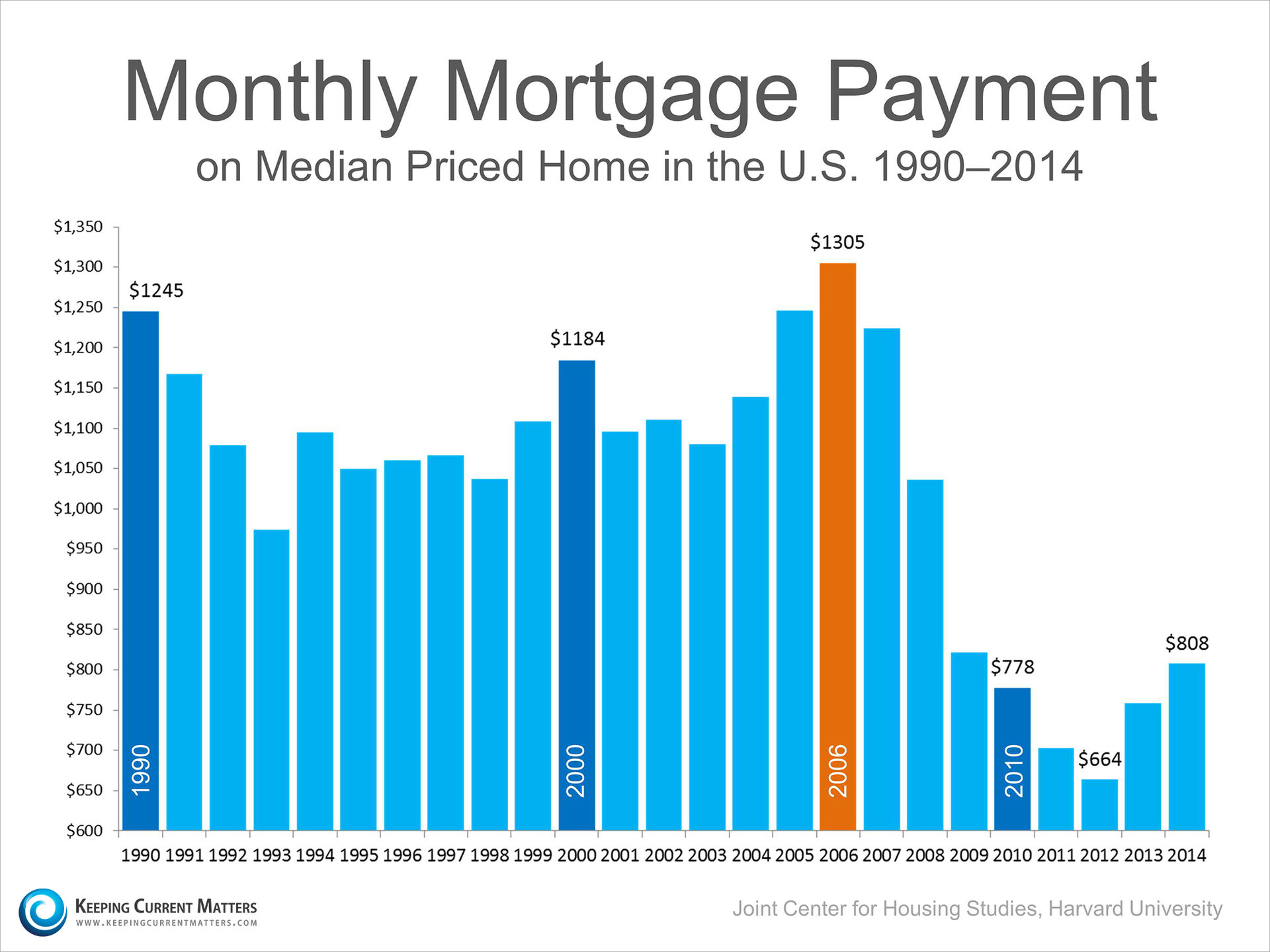
The Main Reason You Should Not Wait to Buy | Keeping Current MattersThe Joint Center for Housing Studies at Harvard University recently released their 2015State of the Nation’s Housing report. The report concentrated on the challenges renters in this country are facing because of the diminishing supply of quality rental units and dramatically escalating rents. However, there was also information buried within the report that revealed that now is definitely the time to buy your first home or move-up to the home of your family’s dreams. With home prices still below peak values and mortgage rates still near historic lows, the monthly mortgage payment on a median priced home is less than at almost any time in the last 25 years. Here is a graph which helps visualize the data from the report:Median Mortgage Payment | Keeping Current Matters

Bottom Line

With home prices increasing and mortgage rates projected to increase, now is the time to buy.